
Praxis exists to lead global collaboration in spinal cord injury research, innovation and care. We translate knowledge to bridge health evidence with real-world delivery. The word praxis means the practical application of a theory – moving knowledge into action. We measure our success through impact, how Praxis makes a difference to the SCI community.
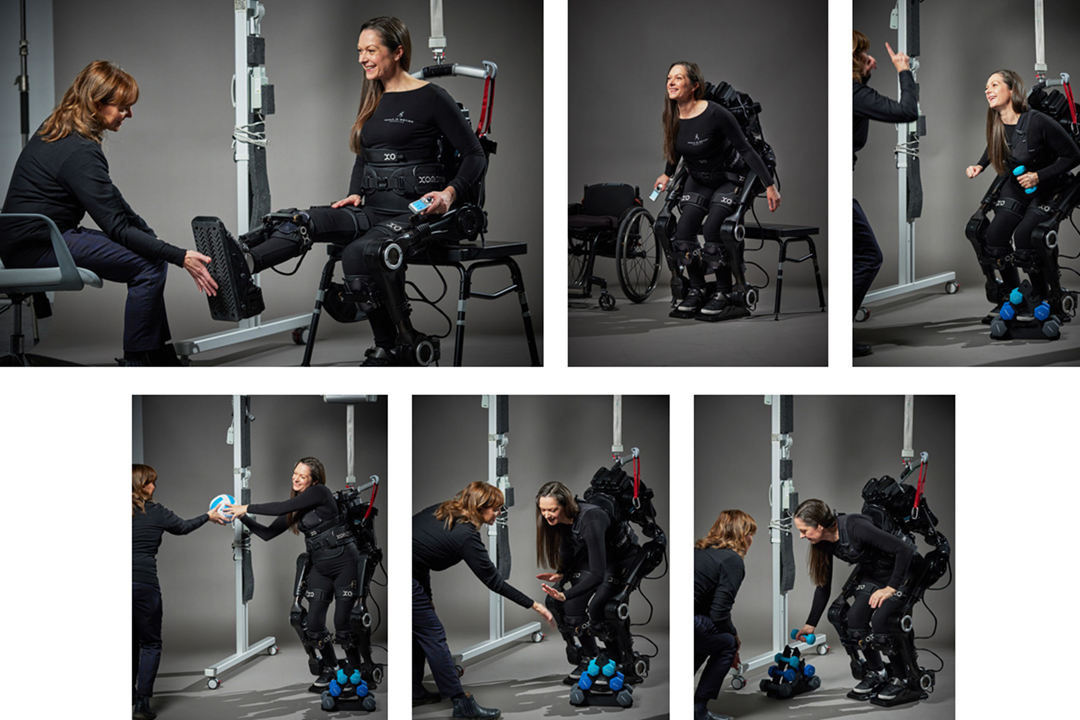
B.C.-based Human in Motion Robotics, a Praxis SCI Accelerate program alum, is developing the next generation of self-balancing exoskeletons to deliver mobility and independence for people following spinal cord injury.
HMR grew out of Simon Fraser University’s School of Mechatronics research. As a Praxis innovations program alum, the company has benefited from SCI lived experience mentoring. In addition, Chloe Angus who is their Director of Human Centred Design and User Engagement, brings a lived experience perspective to the company since using bulky exoskeletons during rehab from her non-traumatic SCI.
Sitting may be the new smoking but for those with SCI there is often no independent option for mobility. Wheelchairs–either manual or power assisted–offer mobility but these require the user to remain seated. There are few options for assistance into a standing position. Staying seated brings a slew of complications, such as overheating and pressure injuries.
Traditional exoskeletons have been bulky and require help from attendants to suit up and when on the move. The HMR exoskeleton aims to help SCI patients regain independence and ability to move over uneven ground. It also delivers the critical option for moving between standing and sitting throughout the day, alleviating issues associated with prolonged sitting such as pressure injuries.
HMR is now working with Canada’s DND veterans and a Toronto rehab hospital to evaluate their exoskeleton as the first viable mobility device that is fully autonomous. The company has also been successful recently in raising $10 million in Series A closed funding from Beno Holdings, a prominent Korean firm focused on technology investments.
HMR also has a grant from Innovation Solutions Canada, where the prototype is being tested in a real environment in University of Toronto.